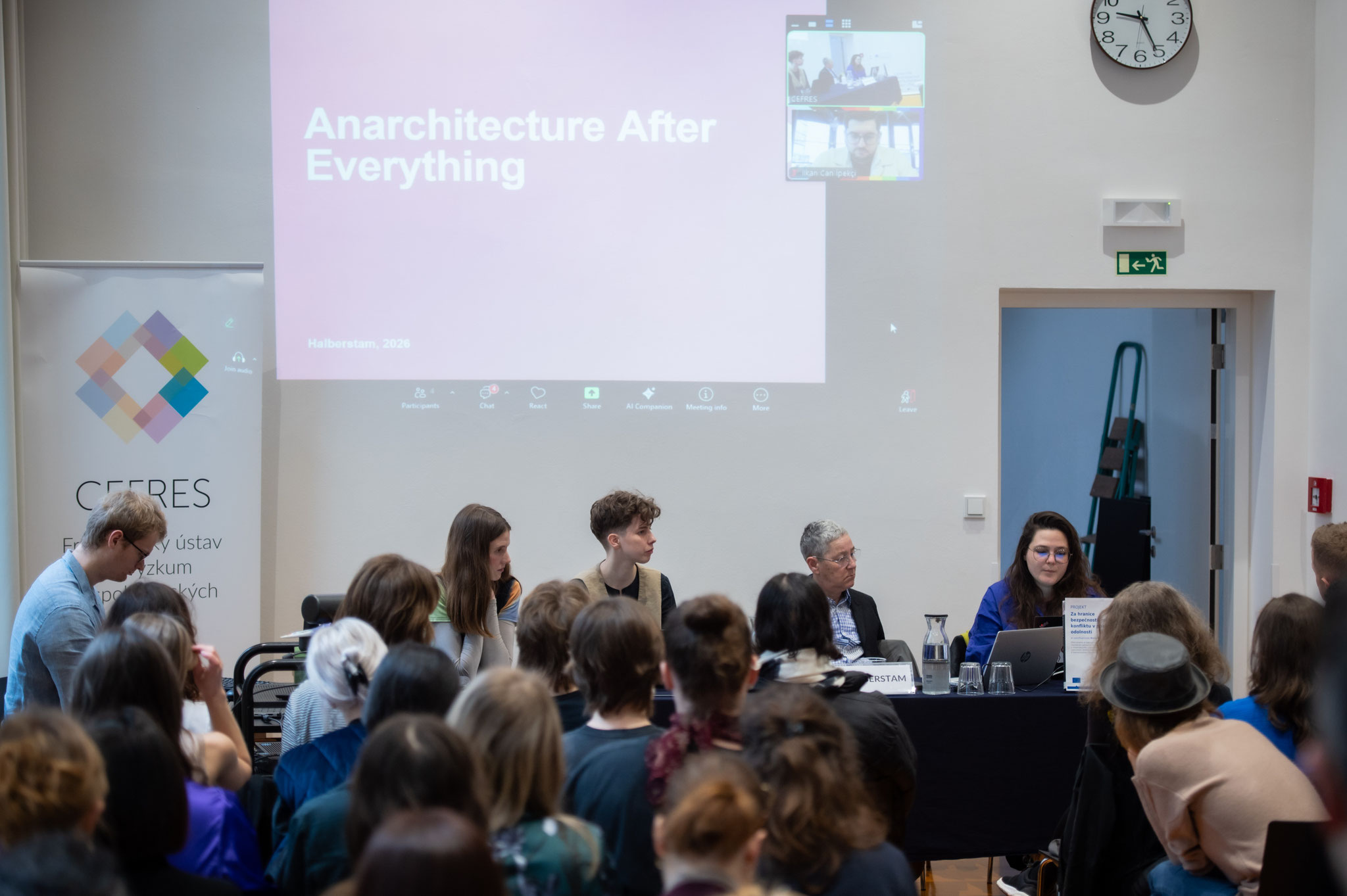
La conférence « Queer Materiality: Becoming-Relations » a réuni des doctorant·es et des jeunes chercheur·euses lors de cet événement de deux jours comprenant plusieurs présentations
interdisciplinaires ainsi que deux conférences keynote données par Jack Halberstam (Université Columbia, États-Unis) et Bogdan Popa (Université Transilvania de Brașov, Roumanie). Le programme
s’est conclu par un débat autour du documentaire de Klára Tasovská intitulé « I’m Not Everything I Want to Be », consacré à la photographe tchécoslovaque Libuše Jarcovjáková. La conférence a été
ouverte par Ana Cuesta, présidente de l'association Choisir la cause des femmes qui a soutenu l'événement et participé à l'organisation.
L’événement a ouvert un espace critique pour réfléchir à l’interaction entre l’expérience personnelle, la représentation visuelle et des contextes socio-politiques plus larges, notamment le
socialisme soviétique ou post-soviétique, la normalisation et les mécanismes de la propagande. Les participant·es ont abordé un large éventail de sujets, tels que la tension entre normes et
transgressions, le rôle des espaces narratifs et discursifs dans la littérature, l’art et les technologies numériques, ainsi que les dimensions matérielles des luttes sociales contemporaines. Une
attention particulière a été accordée à l’activisme, à la théorie et à l’esthétique queer, aux stratégies de résistance et de solidarité, ainsi qu’à la sensibilisation aux diverses formes de
vulnérabilité. Les contributions ont également exploré la manière dont la philosophie, la sociologie, la littérature et les arts pourraient remettre en cause les cadres bien établis de domination
et de répression, tout en ouvrant de nouvelles possibilités pour l’imaginaire et la pratique queer collectifs.
L'intervention de keynote Jack Halberstam a constitué une contribution majeure. Dans sa conférence, il a examiné les dimensions politiques et narratives de l'échec (failure), ainsi que son
rapport avec l'organisation sociale et spatiale contemporaine à travers le concept d'« anarchitecture ». La deuxième intervention keynote, prononcée par Bogdan Popa, a abordé les réalités
post-socialistes, en mettant particulièrement l'accent sur les transformations culturelles qui façonnent le genre, la sexualité et la représentation en Europe de l'Est.
Toutes les contributions ont souligné l’importance des pratiques artistiques, théoriques et matérielles en tant que lieux de modes d’engagement alternatifs. Dans l’ensemble, la conférence a
contribué à une compréhension plus approfondie de la manière dont des « relationnalités" plus larges — des discussions sur l’écologie queer et la technologie queer — peuvent mener à des
façons queer de penser l’interdépendance, la « corporéalité » et le monde du « plus-que-humain ».
Albin K.
Albín K., PhD., est un philosophe trans, traducteur et militant basé à l’Institut de philosophie de l’Académie slovaque des sciences à Bratislava, en Slovaquie. Il est l’auteur de The Ungraspable as a Philosophical Problem (Brill, 2024). Il est également l’un des cofondateurs de l’initiative émergente Secrétariat permanent pour une Europe queer, féministe et intersectionnelle.
Photo ©AnnaSolcova
English version
The conference “Queer Materiality: Becoming-Relations," brought together doctoral researchers and early-career scholars for a two-day event featuring several interdisciplinary presentations
alongside two keynote lectures delivered by Jack Halberstam (Columbia University, USA) and Bogdan Popa (Transilvania University of Brașov, Romania). The programme concluded with a collective
discussion of Klára Tasovská's documentary “I’m Not Everything I Want to Be” on the Czechoslovak photographer Libuše Jarcovjáková.
The event opened a critical space for reflecting on the interplay between personal experience, visual representation, and broader socio-political contexts, including late socialism,
normalization, and the mechanisms of propaganda. Participants engaged with a wide range of topics, such as the tension between norms and transgressions, the role of narrative and discursive
spaces in literature, art, and digital technologies and the material dimensions of contemporary social struggles. Particular attention was given to queer activism, theory and aesthetics,
strategies of resistance and solidarity, and the cultivation of sensitivity to diverse forms of vulnerability. Contributions also explored how philosophy, sociology, literature, and the arts
might challenge entrenched frameworks of domination and repression, while opening new possibilities for collective queer imagination and practice.
A key contribution was the keynote lecture by Jack Halberstam, who examined the political and narrative dimensions of failure, and its relation to contemporary social and spatial organization
through the concept of "anarchitecture." The second keynote, delivered by Bogdan Popa, addressed post-socialist realities, with a particular focus on the cultural transformations shaping gender,
sexuality, and representation in Eastern Europe.
All contributions underscored the importance of artistic, theoretical, and material practices as sites of alternative modes of engagement. Overall, the conference contributed to a deeper
understanding of how broader relationalities—alongside emerging discussions in queer ecology and queer technology—can lead to queer ways of thinking about interdependence, embodiment, and the
more-than-human world.
Albin K.
Albín K., PhD., is a trans philosopher, translator, and activist based at the Slovak Academy of Sciences, Institute of Philosophy, in Bratislava, Slovakia. He is the author of The Ungraspable as a Philosophical Problem (Brill, 2024). He is also one of the co-founders of the emerging initiative Permanent Secretariat for Queer, Feminist and Intersectional Europe.
Photo ©AnnaSolcova